Driveways
Paver driveways in Woodland Hills.
A driveway is the biggest slab of hardscape you own and the first thing anyone sees. Built right, an interlocking paver drive shrugs off the heat, the clay, and thirty years of daily traffic.
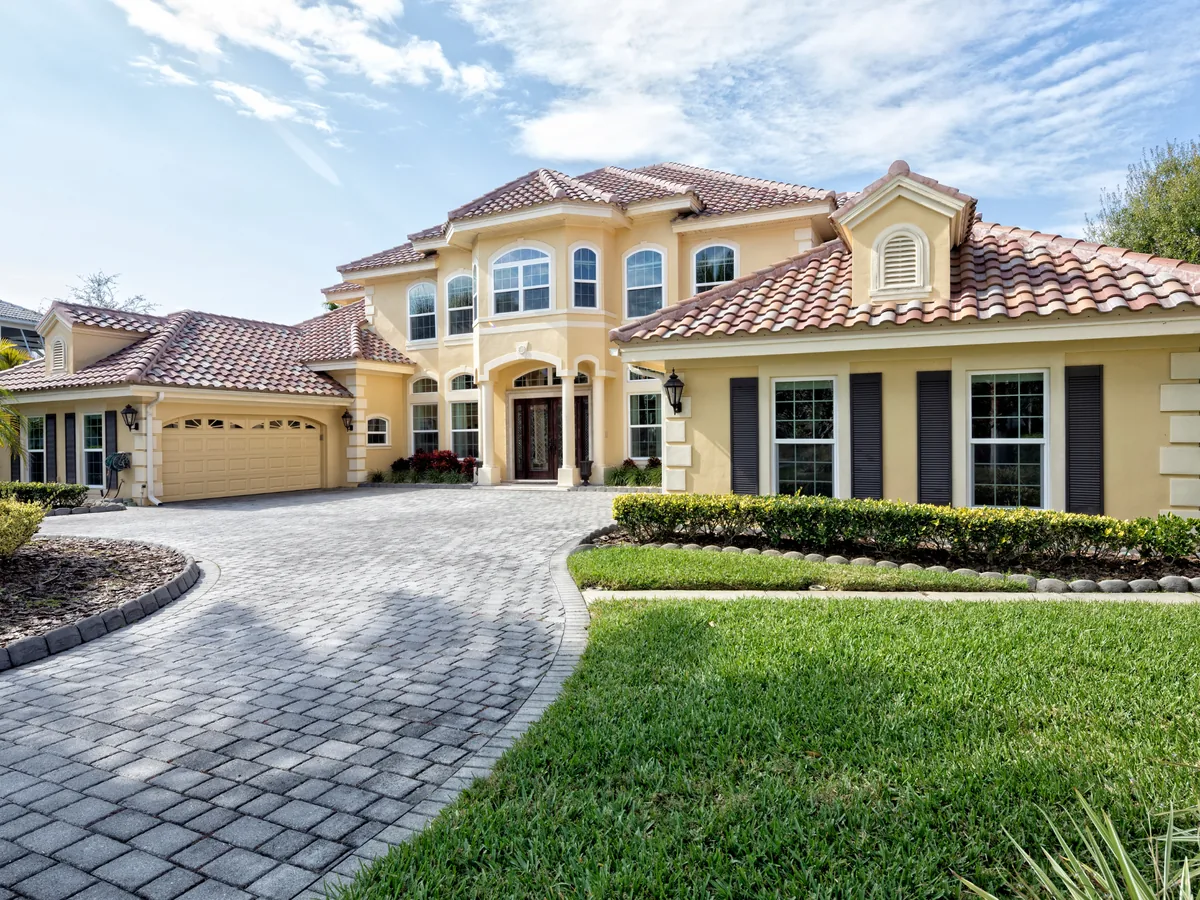
Why so many Woodland Hills driveways are due
Drive any of the tracts between Ventura Blvd and Vanowen and you are looking at homes built in the years right after the war. Most of them still have their original poured driveway, a straight run of concrete that has spent seventy-odd years expanding in summer heat and contracting on the cold nights this part of the Valley is known for. Add clay soil that swells when it gets wet and shrinks when it dries, and the cracking is not bad luck. It is physics.
Interlocking pavers answer that differently. Instead of one rigid plate that has to crack somewhere, you get thousands of small units locked together over a flexible compacted base. When the ground beneath moves, the surface moves with it and the joints absorb the difference. Nothing fractures across the whole driveway, because there is no whole driveway to fracture.
Base work is the job
The pavers are the part you see. The base is the part that decides whether you are happy in ten years. On the clay and silt of the valley floor, water does not soak away, it sits. A base built on soggy clay without a plan turns to pudding and the pavers ride down with it. Here is how we handle it whenever we pave a Woodland Hills property.
- Excavate deep enough. A driveway that takes vehicle loads needs meaningfully more depth than a patio. We dig to the depth the soil and the traffic call for, not to whatever gets us out fastest.
- Separate the layers. A geotextile fabric between the native clay and the new aggregate keeps the fines from migrating up into the base and ruining it. On clay lots this one cheap layer does an enormous amount of work.
- Compact in lifts. Aggregate goes in in measured layers and each one gets compacted before the next. Dumping the whole depth and running a plate over the top is how a base fails.
- Give the water somewhere to go. Slope to a street, a channel drain, or a dry well. On the flats it is about getting water off the pad. On the hillsides it is about controlling where it goes next.
- Lock the edges. Edge restraints along every open side stop the field from spreading under repeated vehicle weight. Without them, the outer courses walk.
Flat lots, orchard parcels, and hillside drives
The ranch tracts on the valley floor
Straight, level, usually 400 to 700 square feet, and easy to work because trucks can pull right up. These are the cleanest driveway jobs in town. The whole game is base depth and drainage, and once those are handled the install moves quickly.
Walnut Acres
The land that used to grow Diamond Walnut trees is now parcels of roughly one to two acres, and the houses sit well back from the street. That means long approach driveways, sometimes a thousand square feet or more, often with a turnaround or a parking apron at the top. There is room to stage material and room to route drainage, so the work is straightforward. It is just a larger canvas, and the price reflects the square footage.
Above the boulevard
Driveways in the foothills south of Ventura Blvd tilt, curve, and sometimes need a retaining wall holding one edge up. The streets that get there are narrow and winding, which limits truck size and adds handling. Grading and drainage work at this scale routinely triggers a geotechnical report and a permit from Los Angeles Building and Safety. A sloped paver drive is absolutely doable, and it grips better than a smooth poured surface, but it is a more involved build and the quote will say so plainly.
Get a fixed price on your driveway.
We measure the drive, check the grade and the drainage, and hand you one written number you can hold us to.
Get a free quoteGet a price for your driveway
Two fields is all we need. We call or text you back with a straight number, no card and no pressure.
Rather just talk? Call (818) 867-8109
Heat, wind, and fire: why the material choice matters here
Woodland Hills is one of the hottest addresses in Los Angeles County, and that is not a figure of speech. On September 6, 2020, the station at Pierce College registered 121 degrees, the highest temperature ever recorded anywhere in the county. Santa Ana winds regularly push hot, dry air across the west Valley for days. A driveway here lives a harder life than one three miles closer to the coast.
Stamped concrete puts its color and texture in a thin surface layer protected by a sealer. Under this sun that sealer chalks and the color washes out, and reviving it means resealing the whole slab every few years. Concrete pavers are pigmented through the body of the unit, so what fades is a fraction of what shows. They are also noncombustible, which counts for something real on the properties south of the boulevard that sit inside a Very High Fire Hazard Severity Zone. A wide, hard, nonflammable surface between the street and the house is a defensible space asset, not just a driveway.
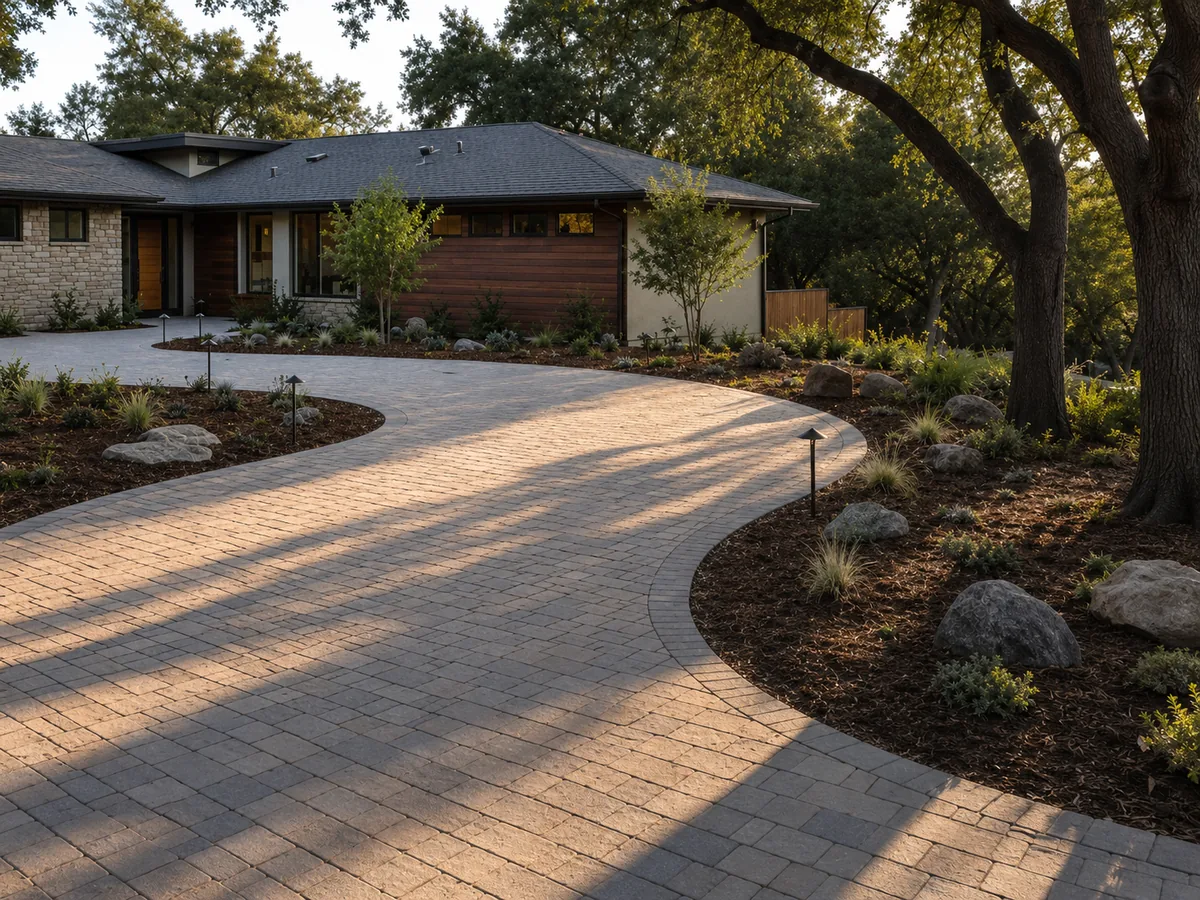
Patterns that suit a driveway
Not every pattern belongs under a car. Herringbone at 45 or 90 degrees is the workhorse, because the interlock resists the twisting force of turning wheels better than anything else. Running bond looks clean and costs less to cut but wants a stronger edge treatment. Basketweave reads traditional and suits the older ranch houses. A soldier or sailor course around the perimeter frames the field and gives the edge restraint something tidy to sit against. Larger-format slab pavers look contemporary and go quickly on a big Walnut Acres approach, though they want a very flat, very well compacted base underneath.
On color, lighter tones stay cooler underfoot, which is worth thinking about in a place that can touch 121 degrees, while charcoals and blended earth tones hide tire marks better. Most people land on a mid-tone field with a darker border.
What the process looks like
- Site visit. We walk the driveway, check slope and drainage, look at how a truck gets in, and talk about pattern and paver.
- Written quote. One fixed number covering demolition, base, material, and labor. No line appears later that was not on the page.
- Demolition. Old concrete or asphalt comes out and gets hauled off.
- Base build. Excavate, lay fabric, place aggregate in lifts, compact each one, set the drainage.
- Setting. Screed the bedding layer, lay the field, cut the edges, install restraints.
- Finish. Joint sand swept in, final plate compaction, cleanup, and a walkthrough with you.
Licensed, insured crews run every install, and the workmanship comes backed by a written warranty.
Behind the house the fall of the yard drives the spec. More on Woodland Hills patio and pool deck work.
Driveways cut into these slopes are photographed as finished.
Related pages
What people ask before a drive
How much does a paver driveway cost in Woodland Hills?
Plan on $16 to $25 per square foot installed. A 600 square foot driveway on a flat ranch lot generally lands near $9,600 to $15,000. Long approach drives on the acre-plus parcels in Walnut Acres cost more because there is simply more ground to cover.
How long does a paver driveway take to install?
A standard flat-lot driveway usually runs five to eight working days from demolition to final compaction. Hillside driveways south of Ventura Blvd take longer because of grade work, retaining details, and the staging limits on narrow canyon streets.
Will a paver driveway hold up in the Woodland Hills heat?
Yes. Concrete pavers carry their color through the full thickness of the unit rather than in a surface coat, so they hold up far better than stamped concrete under the sun that produced a 121 degree reading at Pierce College in September 2020. They are also noncombustible, which matters on the fire-zone lots south of the boulevard.
Do you remove the old concrete or asphalt driveway?
Yes. Demolition, loading, and haul-away are written into the quote. Many of the ranch tracts north of Ventura Blvd still have their original driveways, and pulling one out is part of the job, not an add-on discovered later.
Can pavers handle a sloped hillside driveway?
They can, and they are often the better choice. A sloped driveway in the Santa Monica Mountains foothills needs a deeper compacted base, edge restraints that will not creep, and drainage planned before the first paver is set. Grading work at that scale frequently calls for a geotechnical report and a City of Los Angeles permit.