2026 Price Guide
How much do pavers cost in Woodland Hills?
No teaser number, no bait. Here is what driveways, patios, and walkways really run on this side of the west Valley, and exactly which parts of a Woodland Hills lot push the total up.
Price by project type
| Project | Installed / sq ft | Typical 400 sq ft | Typical 600 sq ft |
|---|---|---|---|
| Walkway | $15 - $20 | $6,000 - $8,000 | $9,000 - $12,000 |
| Patio | $15 - $22 | $6,000 - $8,800 | $9,000 - $13,200 |
| Concrete pavers | $14 - $20 | $5,600 - $8,000 | $8,400 - $12,000 |
| Driveway | $16 - $25 | $6,400 - $10,000 | $9,600 - $15,000 |
Every one of those ranges already includes digging out the pad, building and compacting the base, the paver material itself, bedding sand, edge restraints, joint sand, and the crew hours to set it all. The written quote we hand you is exact to your yard and the paver line you pick, not a national average.
So what does yours come to?
Depends on the size, how the yard falls, and what has to come out before we start. We measure it and tell you.
Get a free quote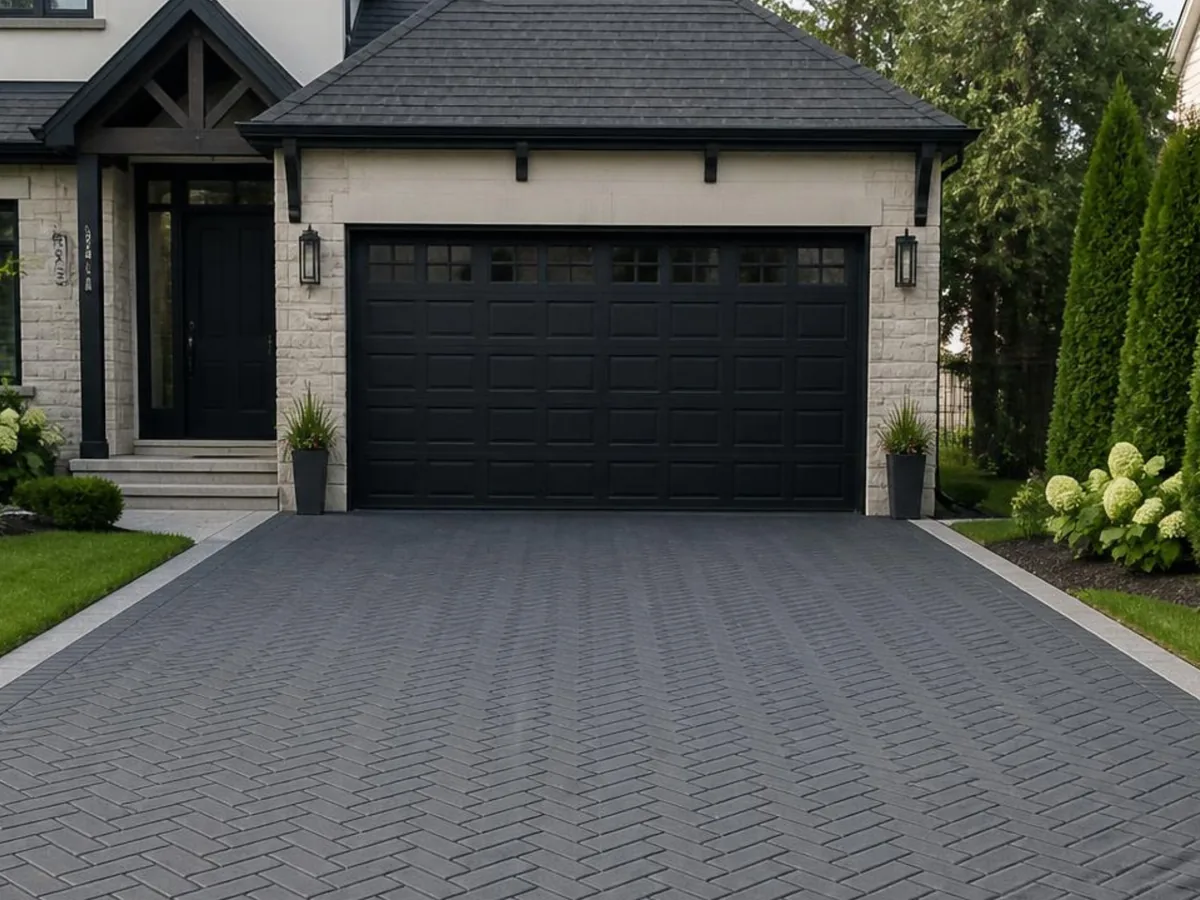
Woodland Hills is really two jobs, and the price knows it
Almost every quote we write here starts with one question: which side of Ventura Blvd is the house on? The answer changes the base build, the equipment, the permits, and the number at the bottom of the page.
North of the boulevard, on the valley floor
The flats running north across the valley floor are post-war ranch tracts with straight concrete or asphalt driveways, most of them well past their useful life. The ground under them is sedimentary clay and silt, and clay does not let rainwater drain away. It holds it. Build a base on saturated clay without dealing with that, and the pad pumps and settles the first wet winter. So a proper flat-lot job here means digging deeper than the textbook minimum, laying a geotextile between the native soil and the new aggregate so the two never mix, compacting in lifts, and giving the surface a real slope to somewhere water can go. That extra base work is the single biggest reason a Woodland Hills flat-lot price sits above a bare-bones bid from a crew that plans to skip it.
South of the boulevard, into the foothills
Once you cross Ventura and start climbing toward Mulholland, the job changes character entirely. Grades swing. Driveways curve and pitch. View patios need something holding the pad up, which means a retaining detail, footings, and drainage behind the wall. The streets are narrow and they wind, so a full-size dump truck often cannot get close, and material gets staged and moved in smaller loads. Add the paperwork: hillside grading and drainage work in the City of Los Angeles routinely triggers a geotechnical report and a grading permit through Building and Safety. All of that is legitimate cost, and any bid that ignores it is a bid that has not looked at your lot.
Walnut Acres and the big parcels
The old Diamond Walnut orchard land is now parcels of roughly one to two acres with ranch houses set back from the street. Nothing about the construction is harder there, but the approach driveways are long, and square footage is square footage. A 1,200 foot driveway at the same per-foot rate is simply a bigger project. The upside is room to work: trucks fit, material stages easily, and there is usually a natural place to route drainage.
Get a price for your project
Two fields is all we need. We call or text you back with a straight number, no card and no pressure.
Rather just talk? Call (818) 867-8109
What moves your number up or down
- Pulling out what is there now. Breaking up and hauling off an old slab or an asphalt apron is real labor and real dump fees. We quote it with the job so it is never a surprise line later.
- Base depth. A patio carries people and furniture. A driveway carries a loaded SUV every day. The driveway base goes deeper and gets compacted harder, and that is most of the price gap between the two.
- Drainage. On the clay flats this is not optional. A channel drain, a dry well, or a graded path to the street is often the difference between a pad that lasts and one that moves.
- Pattern and borders. A running bond cuts fast. Herringbone at 45 degrees with a contrasting soldier border is beautiful and takes noticeably more saw time.
- Paver line. Standard concrete pavers are the value pick. Tumbled, slate-textured, and porcelain lines cost more per square foot before a single hour of labor.
- Access. Wide flat frontage is cheap to work. A gated hillside property on a narrow canyon street with one way in is not.
- Fire zone requirements. Much of the area south of Ventura Blvd sits in a Very High Fire Hazard Severity Zone, where noncombustible hardscape close to the house is a genuine advantage and sometimes shapes the layout.
Pavers versus poured and stamped concrete
A plain poured slab runs somewhere around $8 to $15 per square foot in the Los Angeles market, so yes, it is cheaper on day one. Stamped concrete lands in between. The gap closes over time, and in Woodland Hills it closes faster than most places, because of the heat.
On September 6, 2020, the weather station at Pierce College here in Woodland Hills hit 121 degrees. That is the all-time high ever recorded in Los Angeles County. Add the Santa Ana winds that push hot, dry air through the west Valley for days at a stretch, and you have punishing conditions for any surface that depends on a topical color coat. Stamped concrete does exactly that: the color and the pattern live in a thin surface layer held down by a sealer, and that sealer wants recoating every few years under this sun. Concrete also cracks as the ground below it swells and shrinks, and a crack in a slab is visible across the whole pour.
Pavers behave differently. Color runs through the full thickness of each unit, so sun fade is far less dramatic. The joints let the surface flex with seasonal soil movement instead of fracturing. And when a single paver chips or stains, it gets lifted and swapped, with no patch line to explain to guests. That is why plenty of homeowners here pay more up front and still consider it the cheaper surface.
The comparison plays out across the paver surfaces we lay in Woodland Hills.
Want your actual number?
We come out, walk the lot, measure it, and leave you with a fixed written price. Free, and there is no card to book the visit.
Get a free quoteThree honest ways to spend less
- Keep the shape simple. Rectangles and gentle curves cut fast. Tight radii, inlays, and circle kits eat saw time, and saw time is labor.
- Pick a value paver and spend the savings on the base. A standard concrete paver over a properly built, properly drained base will outlive a premium paver set on a shortcut base every single time.
- Do the whole area at once. Mobilization, excavation, and compaction equipment cost roughly the same whether the crew builds 300 square feet or 700. Phasing a project usually costs more in total than doing it in one go.
What we will not do is cut the base to hit a number. On clay, that is the one saving that always comes back.
Read next
What people ask about price
How much do pavers cost per square foot in Woodland Hills?
Budget about $15 to $25 per square foot installed. Walkways and straightforward backyard patios sit at the bottom of that band. Driveways and anything on a slope south of Ventura Blvd climb toward the top, because the base goes deeper and the site work gets harder.
How much does a paver driveway cost in Woodland Hills?
Figure $16 to $25 per square foot installed. A 600 square foot driveway on a flat ranch lot north of the boulevard usually lands near $9,600 to $15,000. The long approach driveways on the 1 to 2 acre parcels in Walnut Acres run bigger simply because there is more square footage to cover.
Why does the clay soil in the Valley flats affect my price?
The low-lying part of Woodland Hills sits on sedimentary clay and silt that holds water instead of letting it soak away. A base built on that soil often needs deeper excavation, a geotextile separation layer, and a drainage path that carries water off the pad. That is a real line item, and skipping it is how pavers end up sinking.
Does a hillside job south of Ventura Blvd cost more?
Usually yes. Lots in the Santa Monica Mountains foothills bring grade changes, retaining details, narrow winding street access that limits truck size, and in many cases a geotechnical report and a City of Los Angeles grading permit. Each of those adds time and cost compared with a flat tract lot.
Are pavers worth it compared with stamped concrete here?
In this climate, often yes. Pierce College in Woodland Hills recorded 121 degrees on September 6, 2020, the all-time high for Los Angeles County. Stamped concrete relies on a surface color coat and a sealer that both fade under that kind of sun. Pavers carry color through the unit, and a damaged one lifts out and gets replaced instead of needing the whole slab resurfaced.
The ranges above are drawn from driveway jobs in Woodland Hills and patio and pool deck projects. Quick questions live on the Woodland Hills FAQ.